A1-32 · Say where places and people are
In the city
Answer Wo? with in, an and auf plus dative forms such as im, am, in der and auf dem.
About 5 minutes to read · 13 quiz questions

01
Inside a place
Wo? asks where something is. For a location inside a place, use in with the dative. In dem becomes im with masculine and neuter nouns. Feminine die becomes der: in der Schule.
Ben ist im Supermarkt.
Ben is in the supermarket.
Mara ist im Café.
Mara is in the café.
Wir sind in der Schule.
We are in the school.
Ich bin in der Apotheke.
I am in the pharmacy.
Der Supermarkt → im Supermarkt; das Café → im Café; die Schule → in der Schule. These describe a location, not a destination.
02
At a place
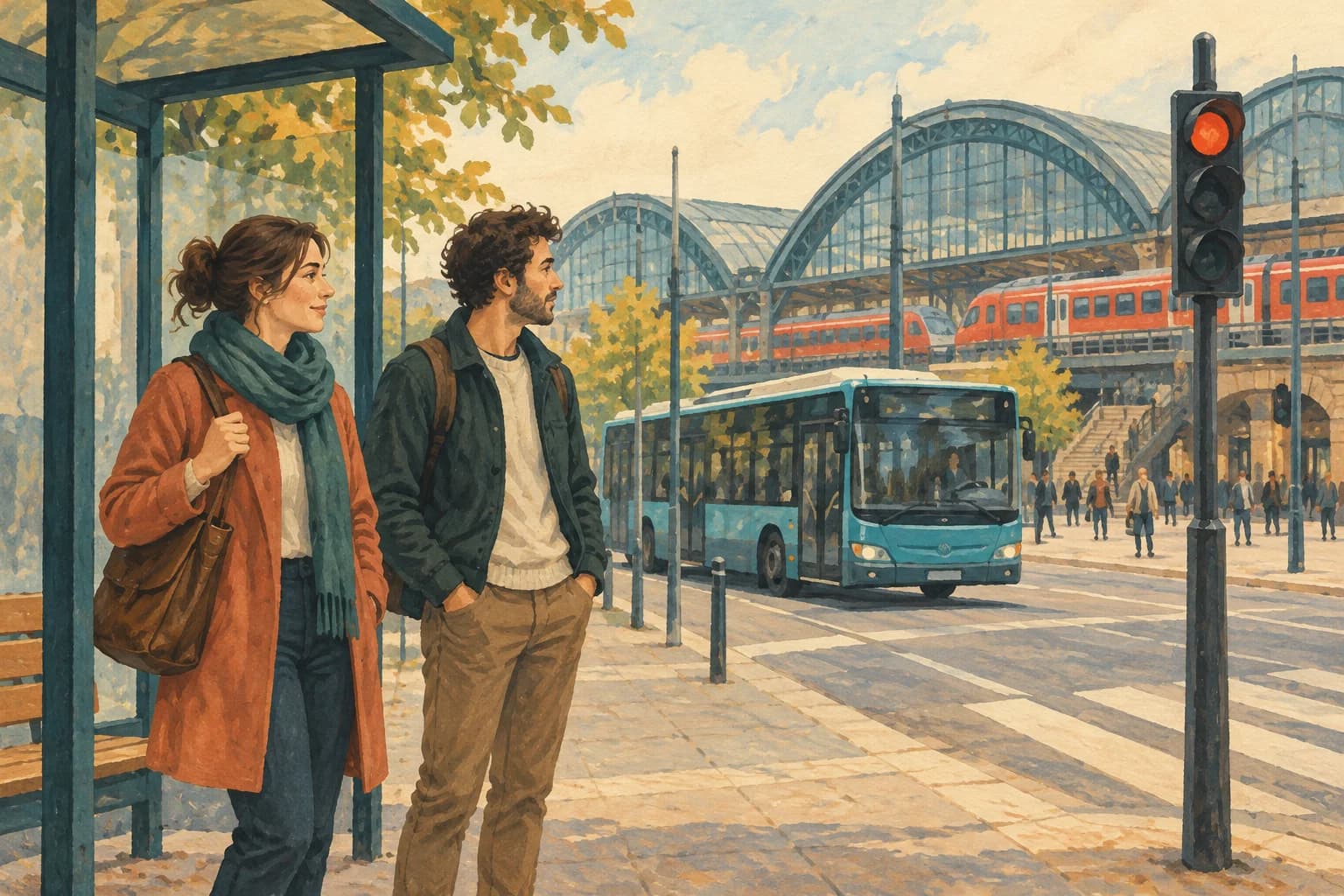
An describes a location at or by something. An dem shortens to am. Die Haltestelle is the stop, der Bahnhof the station and die Ampel the traffic light.
Wir warten am Bahnhof.
We are waiting at the station.
Ben wartet an der Haltestelle.
Ben is waiting at the stop.
Mara steht an der Ampel.
Mara is standing at the traffic light.
Ich bin am Bahnhof.
I am at the station.
Use am Bahnhof for at the station and an der Haltestelle for at the stop. The choice between in and an depends on how you describe the location.

03
On a square or bridge
Auf can describe a location on a surface or in an open area. Use auf dem with masculine or neuter nouns and auf der with feminine nouns. Der Platz means square and die Brücke means bridge.
Ben steht auf dem Platz.
Ben is standing on the square.
Mara steht auf der Brücke.
Mara is standing on the bridge.
Wir sind auf dem Markt.
We are at the market.
Das Buch liegt auf dem Tisch.
The book is lying on the table.
Compare Wo bist du? with Ich bin auf dem Platz. This chapter uses only location. The forms for movement to a destination come later.
Ready to try it?
Check what you remember with 13 short questions.
Loading quiz…