A1-27 · Say whose hand, head or eyes you mean
The body
Use sein, ihr, unser and euer with body parts, choosing the owner first and the noun ending second.
About 5 minutes to read · 13 quiz questions

01
His and her
Sein means his when the owner is a man; ihr means her when the owner is a woman. Before a masculine or neuter singular subject, use sein or ihr. Before a feminine or plural subject, add -e.
Ben ist hier. Sein Kopf ist warm.
Ben is here. His head is warm.
Mara ist hier. Ihre Hand ist kalt.
Mara is here. Her hand is cold.
Ben hat blaue Augen. Seine Augen sind blau.
Ben has blue eyes. His eyes are blue.
Mara ist hier. Ihr Arm ist lang.
Mara is here. Her arm is long.
Der Kopf is the head, der Arm the arm, die Hand the hand and das Auge the eye. The owner's identity chooses sein or ihr; the body-part noun chooses the ending.

02
Our body parts
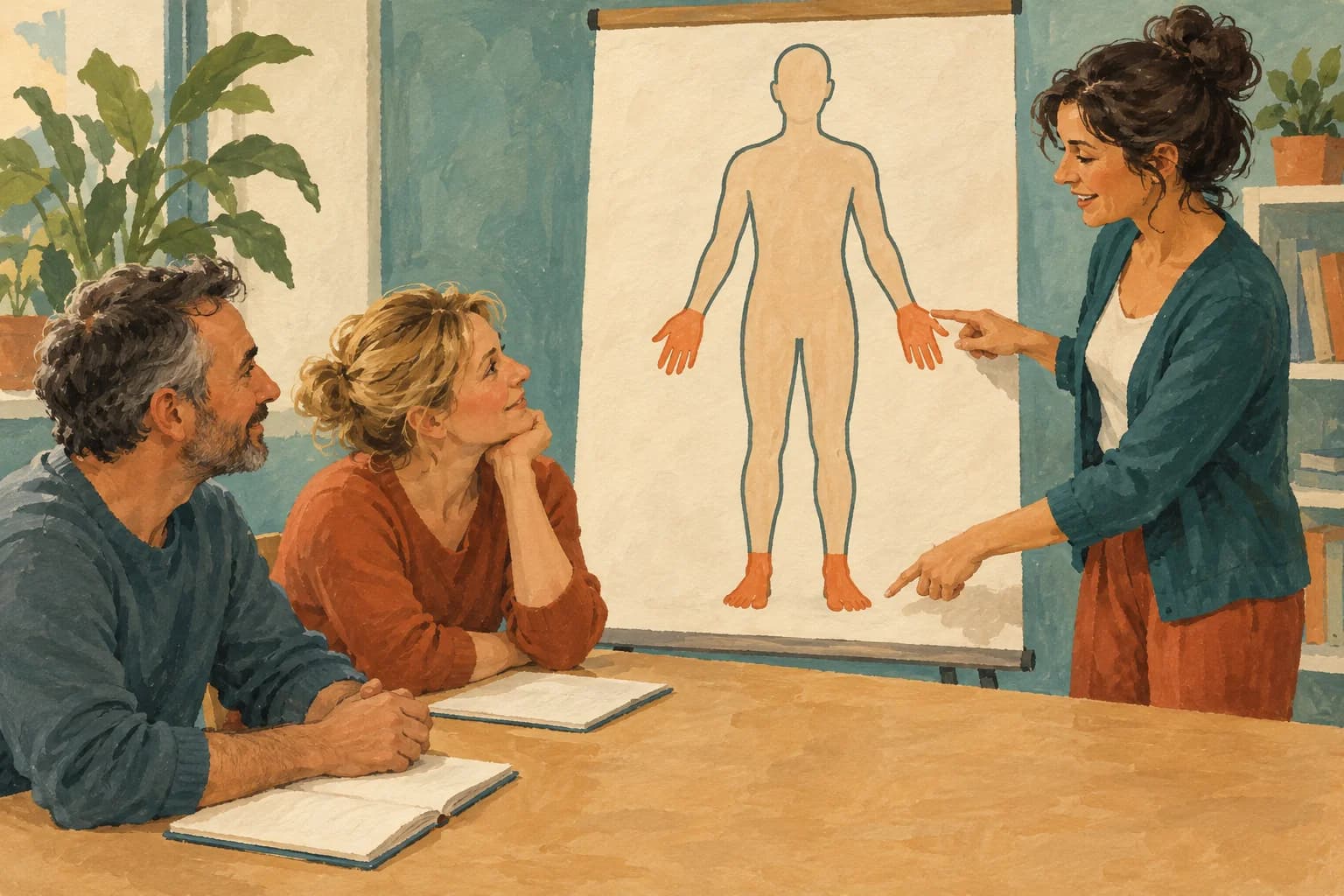
Unser means our. Use unsere with feminine or plural nouns. In a drawing exercise, the class describes a body together. Der Rücken is the back, das Bein the leg, die Nase the nose and die Ohren the ears.
Unser Kopf ist rund.
Our head is round.
Unsere Nase ist klein.
Our nose is small.
Unser Bein ist lang.
Our leg is long.
Unsere Ohren sind klein.
Our ears are small.
Use unser Kopf and unser Bein, but unsere Nase and unsere Ohren. In these examples, the body part is the subject, so no accusative ending is needed.
03
Your, when speaking to a group
Euer means your when speaking informally to more than one person. When you add -e, the middle e usually disappears: eure. The teacher asks two learners about the figure they drew.
Euer Kopf ist rund.
Your head is round.
Eure Hand ist groß.
Your hand is large.
Euer Auge ist blau.
Your eye is blue.
Eure Füße sind klein.
Your feet are small.
Say euer Kopf, euer Auge, eure Hand and eure Füße. Der Fuß becomes die Füße in the plural. Eure refers to the group being addressed, not to a formal Sie.
Ready to try it?
Check what you remember with 13 short questions.
Loading quiz…