B1-76 · Choose adjective endings after alle, beide and manche
Elections
Use the -en ending after alle, beide and manche, compare it with viele and einige, and talk about voting, polling stations and campaigns.
About 5 minutes to read · 12 quiz questions
01
All and both: -en
After alle and beide, adjectives in the plural end in -en: alle neuen Wähler, beide großen Städte. Alle and beide already show the plural clearly, so the adjective takes the weak ending, as after die.
Alle wahlberechtigten Bürger bekommen eine Wahlbenachrichtigung.
All citizens who are entitled to vote receive a polling card.
Beide jungen Kandidatinnen stellen sich auf dem Marktplatz vor.
Both young candidates introduce themselves on the market square.
Alle wichtigen Informationen stehen auf der Wahlbenachrichtigung.
All the important information is on the polling card.
Beide neuen Wahllokale sind in Schulen.
Both new polling stations are in schools.
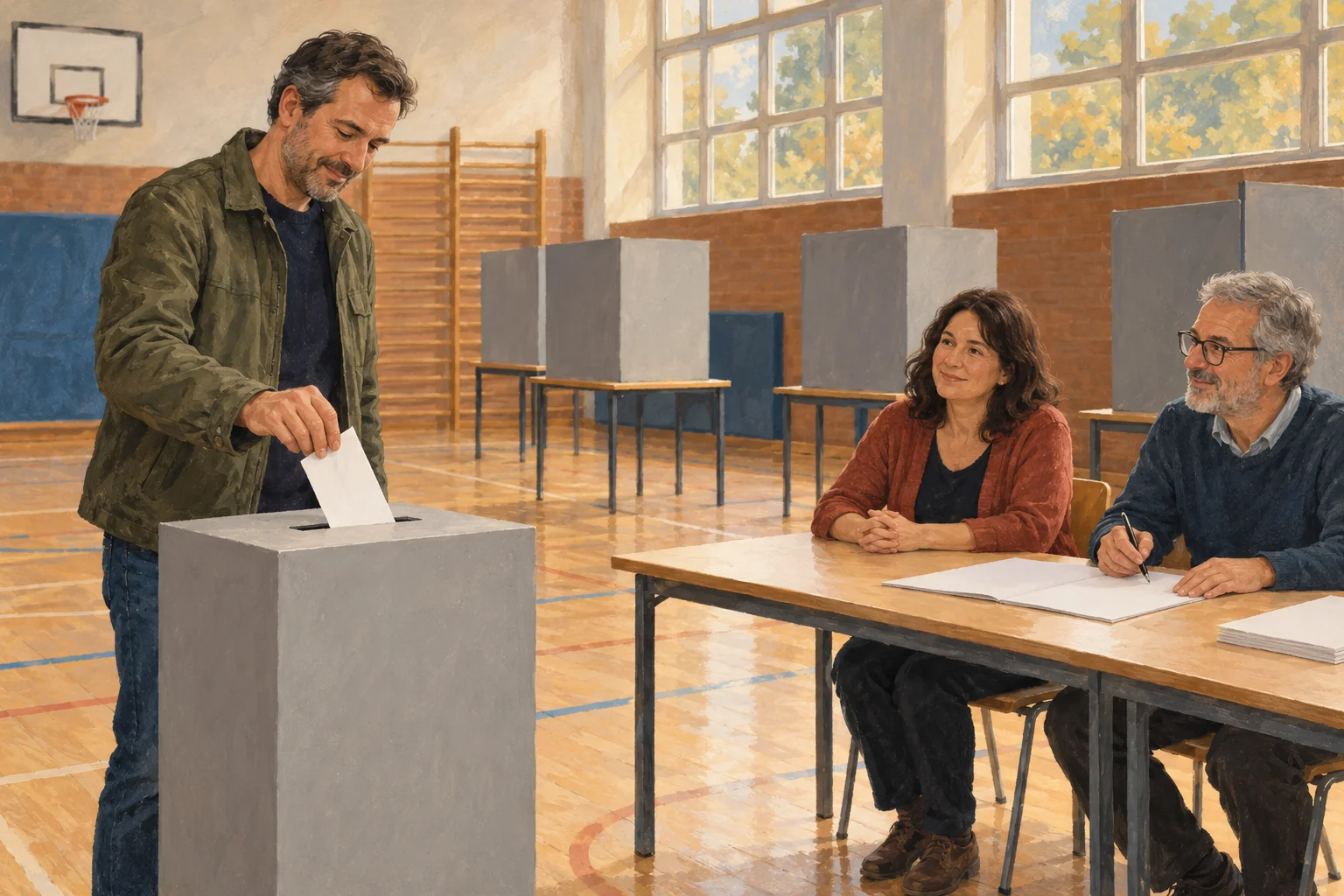
Die Wahl is the election, and wählen means to vote or to elect. Das Wahllokal is the polling station; die Wahlbenachrichtigung is the polling card that arrives by post.
02
Some, many, several
Manche usually takes -en as well: manche älteren Menschen. After viele, einige and mehrere, the adjective takes the strong ending -e instead, because these words do not work like an article: viele junge Menschen.
| Ending | Example |
|---|---|
| weak ending -en | alle neuen Wähler |
| weak ending -en | beide neuen Wähler |
| weak ending -en | manche neuen Wähler |
| strong ending -e | viele neue Wähler |
| strong ending -e | einige neue Wähler |
| strong ending -e | mehrere neue Wähler |
Manche älteren Menschen wählen per Brief.
Some older people vote by post.
Viele junge Menschen gehen zum ersten Mal wählen.
Many young people are voting for the first time.
Einige kleine Parteien sammeln Unterschriften.
Some small parties are collecting signatures.
Mehrere freiwillige Helfer zählen am Abend die Stimmen.
Several volunteers count the votes in the evening.
Per Brief wählen means to vote by post. Die Stimme means both voice and vote, so die Stimmen zählen is to count the votes. Die Unterschrift is a signature.
03
Campaign and results
In the dative plural, alle and beide end in -en, the adjective ends in -en, and the noun adds -n if it can: mit allen neuen Wählern. All three words end in -n.
Die Kandidatin spricht mit allen interessierten Bürgern.
The candidate talks to all interested citizens.
Im Wahlkampf hängen in allen großen Straßen Plakate.
During the campaign, posters hang in all the main streets.
Am Wahlabend spricht Nora mit beiden neuen Abgeordneten.
On election night, Nora talks to both new members of parliament.
Die Ergebnisse aus allen kleinen Orten kommen später.
The results from all the small towns come later.
Der Wahlkampf is the election campaign, and das Plakat is a poster. Das Ergebnis (plural die Ergebnisse) is the result. Der or die Abgeordnete works like an adjective, so after beiden it also ends in -en: mit beiden neuen Abgeordneten.
Ready to try it?
Check what you remember with 12 short questions.
Loading quiz…