B1-10 · Using adjectives as nouns
Generations
Talk about young and older people while keeping adjective endings and respectful wording in view.
About 5 minutes to read · 12 quiz questions
01
An adjective can name a person
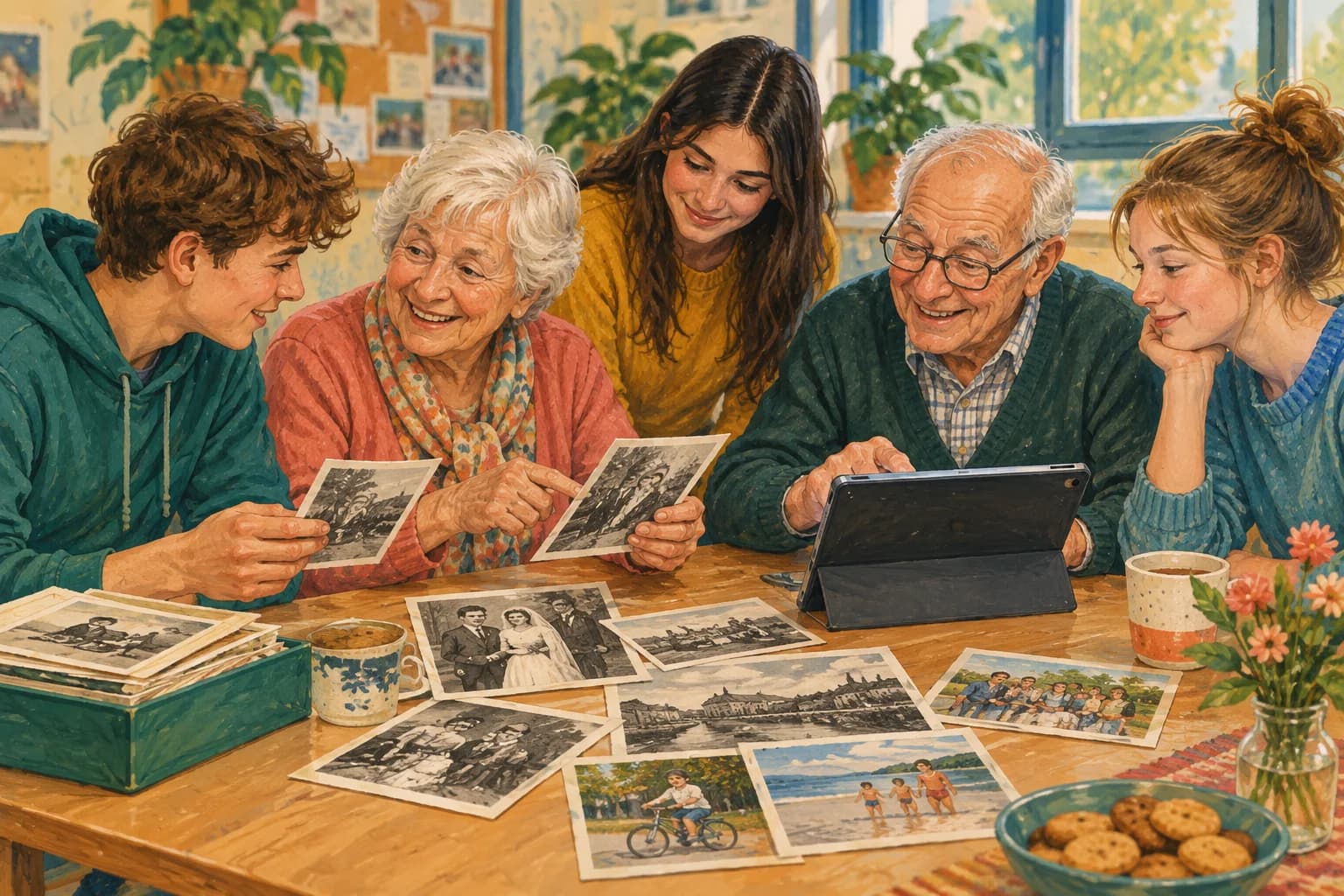
At a neighbourhood café, people of different ages meet for a photo project. German can use an adjective as a noun for a person. Capitalise it, but keep adjective endings: der Jugendliche, die Jugendliche, ein Jugendlicher.
Der Jugendliche bringt alte Fotos mit.
The teenage boy brings old photos.
Die Jugendliche zeigt ihrer Oma ein Video.
The teenage girl shows her grandma a video.
Ein Jugendlicher erklärt die Kamera.
A teenage boy explains the camera.
Eine Jugendliche hört aufmerksam zu.
A teenage girl listens attentively.
With a definite article in the nominative singular, use -e: der Jugendliche, die Jugendliche. Without a noun after it, the adjective itself names the person. With ein for a masculine subject, use -er: ein Jugendlicher.
02
The ending changes with the case
Capital letters do not remove adjective endings. An accusative masculine object has -en, and a dative form after the definite article also has -en. Plural forms depend on the article and case too.
Ich frage den Jugendlichen nach seinem Lieblingsfoto.
I ask the teenage boy about his favourite photo.
Die Fotografin hilft dem Jugendlichen.
The photographer helps the teenage boy.
Die Jugendlichen planen eine Ausstellung.
The teenagers are planning an exhibition.
Jugendliche helfen beim Aufbau.
Teenagers help with setting up.
Compare der Jugendliche, den Jugendlichen and dem Jugendlichen. In the plural, use die Jugendlichen and mit den Jugendlichen. Without an article, a nominative plural has -e: Jugendliche helfen.
03
Talk about generations without labelling everyone
Die Jungen and die Alten can name age groups, but die Alten may sound blunt or dismissive. In everyday conversation, ältere Menschen is often a friendlier choice. Die Älteren means the older people in the group. Shared interests tell us more than age alone.
Die Jungen und die Alten wählen gemeinsam die Fotos aus.
The young and the old choose the photos together.
Die Erwachsenen organisieren die Ausstellung.
The adults organise the exhibition.
Wir sprechen mit den Älteren über ihre Erinnerungen.
We talk with the older people about their memories.
Ältere Menschen erzählen von ihrer Jugend.
Older people talk about their youth.
The same endings appear with Erwachsene and Ältere: die Erwachsenen, mit den Älteren. Keep the capital letter when no noun follows. In ältere Menschen, ältere stays lowercase because Menschen is the noun.
Ready to try it?
Check what you remember with 12 short questions.
Loading quiz…