B1-78 · Tell history with the Präteritum and Plusquamperfekt
Germany 1945–1990
Narrate the division of Germany in the Präteritum and use the Plusquamperfekt for events that had already happened, including after nachdem.
About 5 minutes to read · 12 quiz questions
01
A divided country
History books and documentaries usually tell events in the Präteritum. Regular verbs add -te: endete, teilte. Irregular verbs change the stem: entstand, begann. Plural subjects add -n or -en: sie teilten, sie entstanden.
1945 endete der Zweite Weltkrieg in Europa.
In 1945, the Second World War ended in Europe.
Die Siegermächte teilten Deutschland in vier Besatzungszonen.
The victorious powers divided Germany into four occupation zones.
1949 entstanden zwei deutsche Staaten: die Bundesrepublik Deutschland und die DDR.
In 1949, two German states were founded: the Federal Republic of Germany and the GDR.
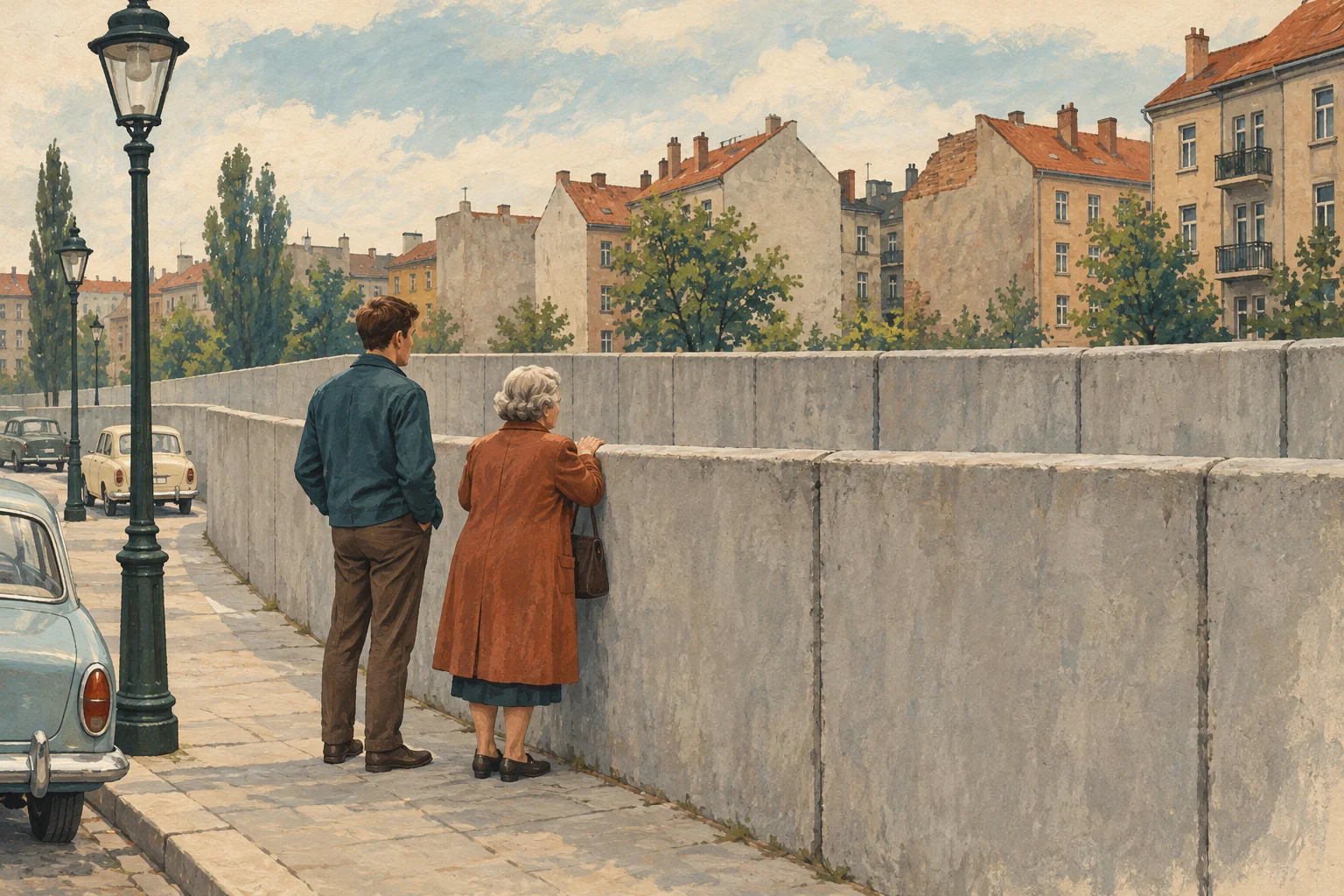
Am 13. August 1961 begann der Bau der Berliner Mauer.
On 13 August 1961, the construction of the Berlin Wall began.
Die Siegermächte are the victorious Allied powers, and die Besatzungszone is an occupation zone. Die DDR is the GDR. A year alone needs no preposition: 1949 or im Jahr 1949, never in 1949.
02
What had happened before
To show that one past event happened before another, use the Plusquamperfekt: hatte or war plus the past participle. Verbs of movement, such as gehen and ziehen, use war; most other verbs use hatte.
| Tense | to go | to move | to see | to separate |
|---|---|---|---|---|
| Präteritum | er ging | er zog | er sah | er trennte |
| Plusquamperfekt | er war gegangen | er war gezogen | er hatte gesehen | er hatte getrennt |
Vor dem Mauerbau waren schon viele Menschen in den Westen gegangen.
Before the Wall was built, many people had already gone to the West.
Die Familie hatte ihre Verwandten jahrelang nicht gesehen.
The family had not seen their relatives for years.
Onkel Paul war 1960 nach West-Berlin gezogen.
Uncle Paul had moved to West Berlin in 1960.
Meine Großeltern hatten sich in Leipzig kennengelernt.
My grandparents had met in Leipzig.
Der Mauerbau is the building of the Wall. Hatte and war change with the subject: die Familie hatte, die Großeltern hatten.
03
A family story
In a story, the Präteritum carries the main events, and the Plusquamperfekt explains what had happened earlier. After nachdem, use the Plusquamperfekt for the earlier action and the Präteritum in the main clause.
Nachdem Paul nach West-Berlin gezogen war, schrieb er jede Woche Briefe.
After Paul had moved to West Berlin, he wrote letters every week.
Nach dem Mauerbau konnten sich die beiden Schwestern nur noch selten sehen.
After the Wall was built, the two sisters could only rarely see each other.
Die Großmutter weinte, weil sie ihre Schwester lange nicht gesehen hatte.
Grandmother cried because she had not seen her sister for a long time.
Nachdem die Familie den Antrag gestellt hatte, wartete sie drei Jahre auf eine Antwort.
After the family had submitted the application, they waited three years for an answer.
In a subordinate clause with nachdem or weil, hatte or war goes to the end. Der Antrag is an application, and die Antwort is the answer.
Ready to try it?
Check what you remember with 12 short questions.
Loading quiz…