B1-67 · Explain customs with man instead of the passive
Traditions
Explain Karneval, the Oktoberfest and Advent customs with man and an active verb as an everyday alternative to the passive.
About 5 minutes to read · 12 quiz questions
01
man instead of the passive
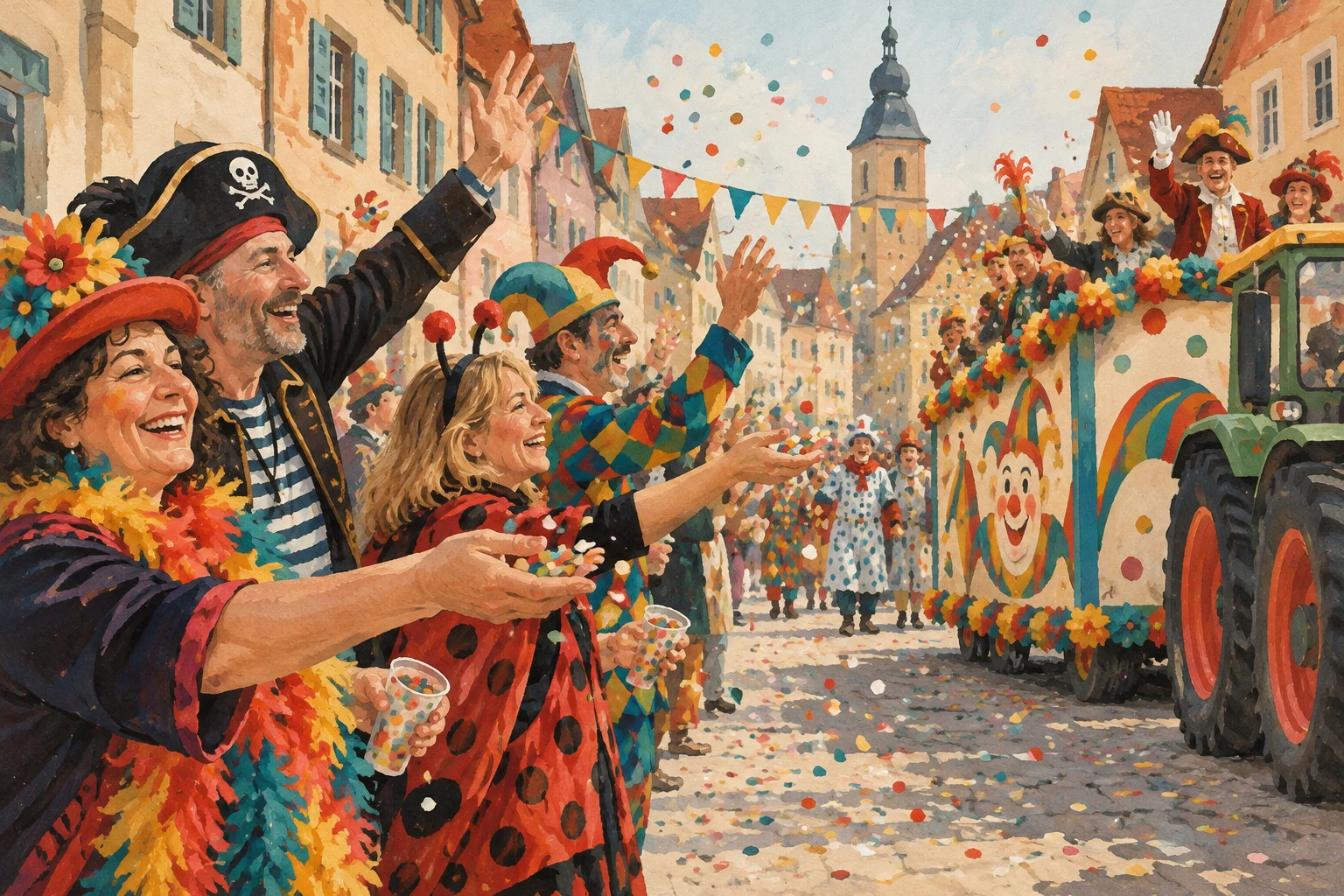
Instead of the passive, German often uses man with an active verb: Im Rheinland feiert man Karneval instead of Im Rheinland wird Karneval gefeiert. Man means people in general, and the meaning stays the same. It just sounds more everyday.
Im Rheinland feiert man Karneval mit Umzügen und Kostümen.
In the Rhineland, people celebrate carnival with parades and costumes.
Zu Karneval trägt man oft ein Kostüm.
At carnival, people often wear a costume.
In München feiert man jedes Jahr das Oktoberfest.
In Munich, people celebrate the Oktoberfest every year.
Auf dem Oktoberfest isst man Brezeln und fährt Karussell.
At the Oktoberfest, people eat pretzels and ride the carousel.
Man always takes the er/sie/es form of the verb, so never write man feiern. Der Brauch means the custom, das Kostüm the costume and der Umzug the parade.
02
From passive to man
Compare the two styles: Der Adventskranz wird aufgestellt becomes Man stellt den Adventskranz auf. The subject of the passive sentence becomes the accusative object of the active sentence, so der changes to den.
| Style | Karneval | Advent |
|---|---|---|
| passive | Kostüme werden getragen. | Der Kranz wird aufgestellt. |
| with man | Man trägt Kostüme. | Man stellt den Kranz auf. |
Im Advent stellt man einen Adventskranz auf den Tisch.
During Advent, people put an Advent wreath on the table.
Jeden Sonntag zündet man eine neue Kerze an.
Every Sunday, people light a new candle.
Im Dezember besucht man gern den Weihnachtsmarkt.
In December, people like to visit the Christmas market.
Den Adventskranz stellt man oft schon Ende November auf.
People often put up the Advent wreath at the end of November.
Advent is the time of the four Sundays before Christmas. An Adventskranz has four candles, and one more is lit each Sunday. Der Weihnachtsmarkt is the Christmas market.
03
Explaining customs
Man is handy when you explain a custom to visitors: Bei uns macht man das so. In a question, man comes right after the verb: Was macht man im Advent? The verb still takes the er/sie/es form.
Was macht man eigentlich im Advent?
What do people actually do during Advent?
Man backt Plätzchen und singt Lieder.
People bake biscuits and sing songs.
Wie feiert man bei euch Karneval?
How do people celebrate carnival where you live?
Bei uns verkleidet man sich und geht auf die Straße.
Where we live, people dress up and go out into the streets.
Man means people in general; jemand means one unknown person. The reflexive pronoun for man is sich: man verkleidet sich means people dress up. Plätzchen are Christmas biscuits.
Ready to try it?
Check what you remember with 12 short questions.
Loading quiz…