B2-56 · Predict and guess with Futur I and II
Artificial intelligence
Use Futur I for predictions, Futur II for what will be finished by a future point, and both with wohl for assumptions.
About 5 minutes to read · 12 quiz questions
01
Predict with Futur I
For predictions and announced intentions, German can use Futur I: a form of werden plus an infinitive at the end. In articles about technology it sounds confident and slightly formal: Künstliche Intelligenz wird viele Aufgaben übernehmen. For simple plans with a time word such as morgen, the present tense is also common.
Künstliche Intelligenz wird viele Routineaufgaben übernehmen.
Artificial intelligence will take over many routine tasks.
Selbstfahrende Busse werden bald in vielen Städten unterwegs sein.
Self-driving buses will soon be on the road in many towns.
Viele Berufe werden sich durch die Automatisierung verändern.
Many jobs will change because of automation.
Ich werde den neuen Assistenten morgen ausprobieren.
I will try out the new assistant tomorrow.
Die künstliche Intelligenz (KI) means artificial intelligence, die Automatisierung automation and übernehmen to take over. With a reflexive verb, sich stays near werden: Viele Berufe werden sich verändern.
02
Look back from the future with Futur II
Futur II describes something that will be finished by a point in the future: werden plus participle plus haben or sein. A time phrase such as bis dahin or in zehn Jahren usually marks that point. The auxiliary is the same one the verb uses in the Perfekt.
Bis zum Ende des Jahrzehnts wird KI viele Aufgaben in der Verwaltung übernommen haben.
By the end of the decade, AI will have taken over many administrative tasks.
In zehn Jahren werden die meisten Firmen KI eingeführt haben.
In ten years, most companies will have introduced AI.
Bis dahin wird sich auch die Ausbildung verändert haben.
By then, training will also have changed.
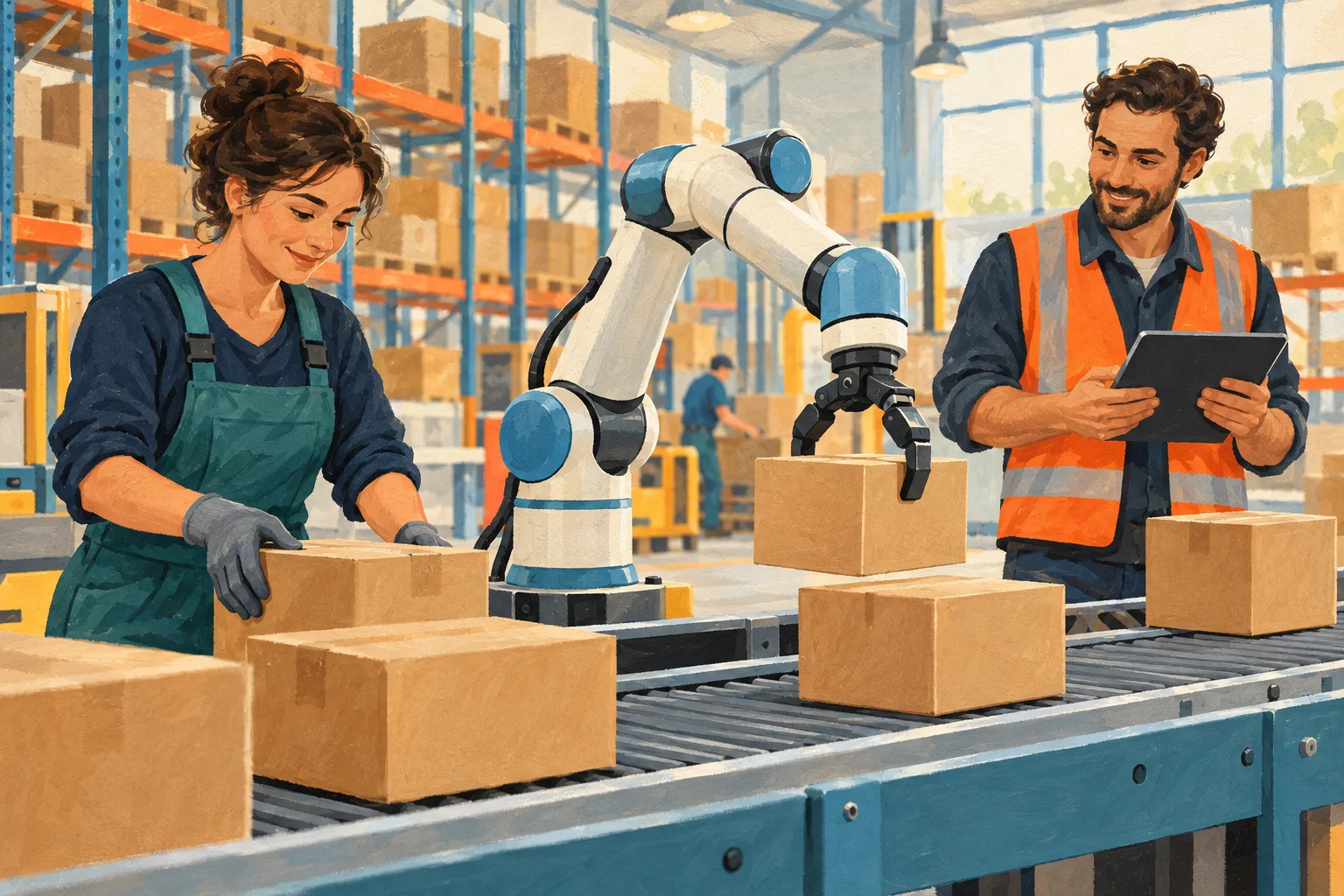
Bis zum Sommer werden die Roboter in der Lagerhalle angekommen sein.
By summer, the robots will have arrived at the warehouse.
Ankommen uses sein, so its Futur II ends in angekommen sein. Die Verwaltung means administration and einführen to introduce. Bis + date or bis zum Ende ... names the deadline.
03
Guess what is happening or has happened
With wohl, both future forms can express an assumption instead of a prediction. Futur I + wohl is a guess about the present; Futur II + wohl is a guess about something that has already happened. This is common when technology behaves unexpectedly.
| Use | Form | Example |
|---|---|---|
| prediction about the future | wird ... übernehmen | KI wird viele Aufgaben übernehmen. |
| finished by a future point | wird ... übernommen haben | Bis dahin wird KI viele Aufgaben übernommen haben. |
| assumption about now | wird wohl ... sein | Der Server wird wohl überlastet sein. |
| assumption about the past | wird wohl ... gemacht haben | Die Software wird wohl einen Fehler gemacht haben. |
Der Chatbot antwortet nicht, der Server wird wohl überlastet sein.
The chatbot isn't answering; the server is probably overloaded.
Die Software wird wohl einen Fehler gemacht haben.
The software has probably made a mistake.
Eva ist nicht im Büro, sie wird wohl schon nach Hause gegangen sein.
Eva isn't in the office; she has probably already gone home.
Das Programm wird die Daten wohl falsch interpretiert haben.
The program has probably misinterpreted the data.
Überlastet means overloaded and interpretieren to interpret. The participle and haben or sein stand together at the very end: Die Software wird wohl einen Fehler gemacht haben.
Ready to try it?
Check what you remember with 12 short questions.
Loading quiz…