B2-81 · Place historical events in years, decades and centuries
Germany 1871–1933
Use year, decade and century expressions to describe the German Empire and the Weimar Republic.
About 5 minutes to read · 12 quiz questions
01
Place events within a century
Use im Jahr before a particular year. For a broad period, Mitte des 19. Jahrhunderts means the middle of the nineteenth century and Ende des 19. Jahrhunderts its end. Des Jahrhunderts is genitive, while im 19. Jahrhundert contains the dative.
| period | expression |
|---|---|
| a single year | im Jahr 1871 |
| a century | im 19. Jahrhundert |
| middle of a century | Mitte des 19. Jahrhunderts |
| end of a century | Ende des 19. Jahrhunderts |
Im Jahr 1871 wurde das Deutsche Kaiserreich gegründet.
The German Empire was founded in 1871.
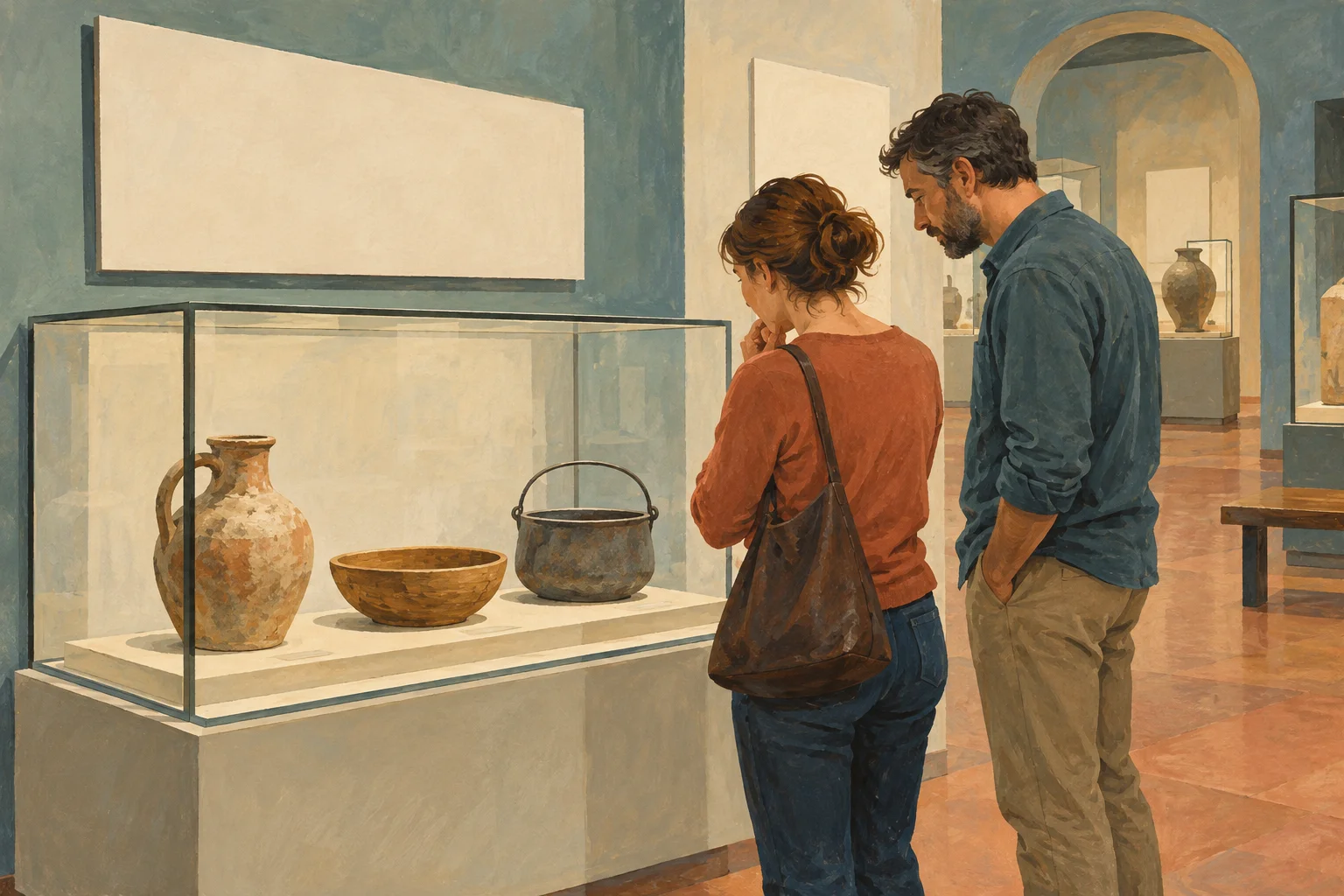
Mitte des 19. Jahrhunderts beginnt der Überblick im Museum.
The overview in the museum begins in the middle of the nineteenth century.
Ende des 19. Jahrhunderts bestand das Deutsche Kaiserreich.
The German Empire existed at the end of the nineteenth century.
Die Ausstellung ordnet die Gründung des Kaiserreichs dem 19. Jahrhundert zu.
The exhibition places the founding of the Empire in the nineteenth century.
The dot after 19 marks an ordinal number, read here as neunzehnten. Das Kaiserreich means the Empire, and die Gründung means founding. The museum visit is fictional; the founding of the German Empire in 1871 is a historical fact.
02
Describe the transition to a republic
Combine im with a month and a year, as in im November 1918. Zu Beginn des Jahres names the beginning of a year, while in den Jahren introduces more than one year. These expressions help distinguish the end of the monarchy in 1918 from the transition to the Weimar Republic across 1918 and 1919.
Im November 1918 endete die Monarchie in Deutschland.
The monarchy in Germany ended in November 1918.
Zu Beginn des Jahres 1919 war Deutschland keine Monarchie mehr.
At the beginning of 1919, Germany was no longer a monarchy.
Der Übergang vom Kaiserreich zur Weimarer Republik erfolgte in den Jahren 1918 und 1919.
The transition from the Empire to the Weimar Republic took place in 1918 and 1919.
Die Ausstellung behandelt den Übergang von der Monarchie zur Republik.
The exhibition covers the transition from monarchy to republic.
Die Monarchie is a monarchy and die Republik a republic. Der Übergang means transition. In den Jahren uses dative plural, but zu Beginn des Jahres contains a genitive phrase after Beginn.
03
Distinguish a decade from a single year
In den 1920ern means in the 1920s, rather than in the single year 1920. In den 1920er-Jahren is the fuller form, often used in historical writing. In den Zwanzigerjahren has the same meaning when the century is clear from context. After Beginn use the genitive der 1930er-Jahre; after in use the dative den 1930er-Jahren in these time expressions.
| period | expression |
|---|---|
| in the 1920s, short form | in den 1920ern |
| in the 1920s, full form | in den 1920er-Jahren |
| in the twenties, written out | in den Zwanzigerjahren |
| beginning of the 1930s | zu Beginn der 1930er-Jahre |
| in the course of 1923 | im Verlauf des Jahres 1923 |
In den frühen 1920ern bestand die Weimarer Republik.
The Weimar Republic existed in the early 1920s.
Im Verlauf des Jahres 1923 erreichte die Hyperinflation ihren Höhepunkt.
In the course of 1923, hyperinflation reached its peak.
Zu Beginn der 1930er-Jahre bestand die Weimarer Republik noch.
At the beginning of the 1930s, the Weimar Republic still existed.
Im Jahr 1933 endete die Weimarer Republik.
The Weimar Republic ended in 1933.
Früh narrows a decade to its early years, as in in den frühen 1920ern. Im Verlauf des Jahres means in the course of the year. Die Hyperinflation means an extreme rise in prices, and ihren Höhepunkt erreichen means to reach its peak.
Ready to try it?
Check what you remember with 12 short questions.
Loading quiz…