B2-36 · Choose the right tense in a news report
Natural disasters
Open a report with the Perfekt, tell the events in the Präteritum, look back with the Plusquamperfekt and describe the current situation in the Präsens.
About 5 minutes to read · 12 quiz questions
01
Open the report with the Perfekt
A news report usually opens with the Perfekt: it tells readers what has happened and why it matters now. Ein Sturm hat Bäume entwurzelt. Verbs of movement or change of state take sein: Der Fluss ist über die Ufer getreten.
Ein Sturm hat in der Nacht zahlreiche Bäume entwurzelt.
A storm has uprooted numerous trees overnight.
In mehreren Orten ist der Fluss über die Ufer getreten.
In several places the river has burst its banks.
Die Feuerwehr hat über hundert Menschen aus ihren Häusern gerettet.
The fire brigade has rescued over a hundred people from their homes.
Nach ersten Angaben ist niemand schwer verletzt worden.
According to initial reports, no one has been seriously injured.
The events in this report are fictional. Über die Ufer treten means to burst its banks and entwurzeln to uproot. In the passive Perfekt, werden appears as worden: ist verletzt worden.
02
Tell the events in the Präteritum
After the opening, written reports usually switch to the Präteritum to tell the events in order: Gegen Mitternacht stieg der Pegel. Die Helfer füllten Sandsäcke. In conversation, most people would use the Perfekt instead.
Gegen Mitternacht stieg der Pegel plötzlich stark an.
Around midnight the water level suddenly rose sharply.
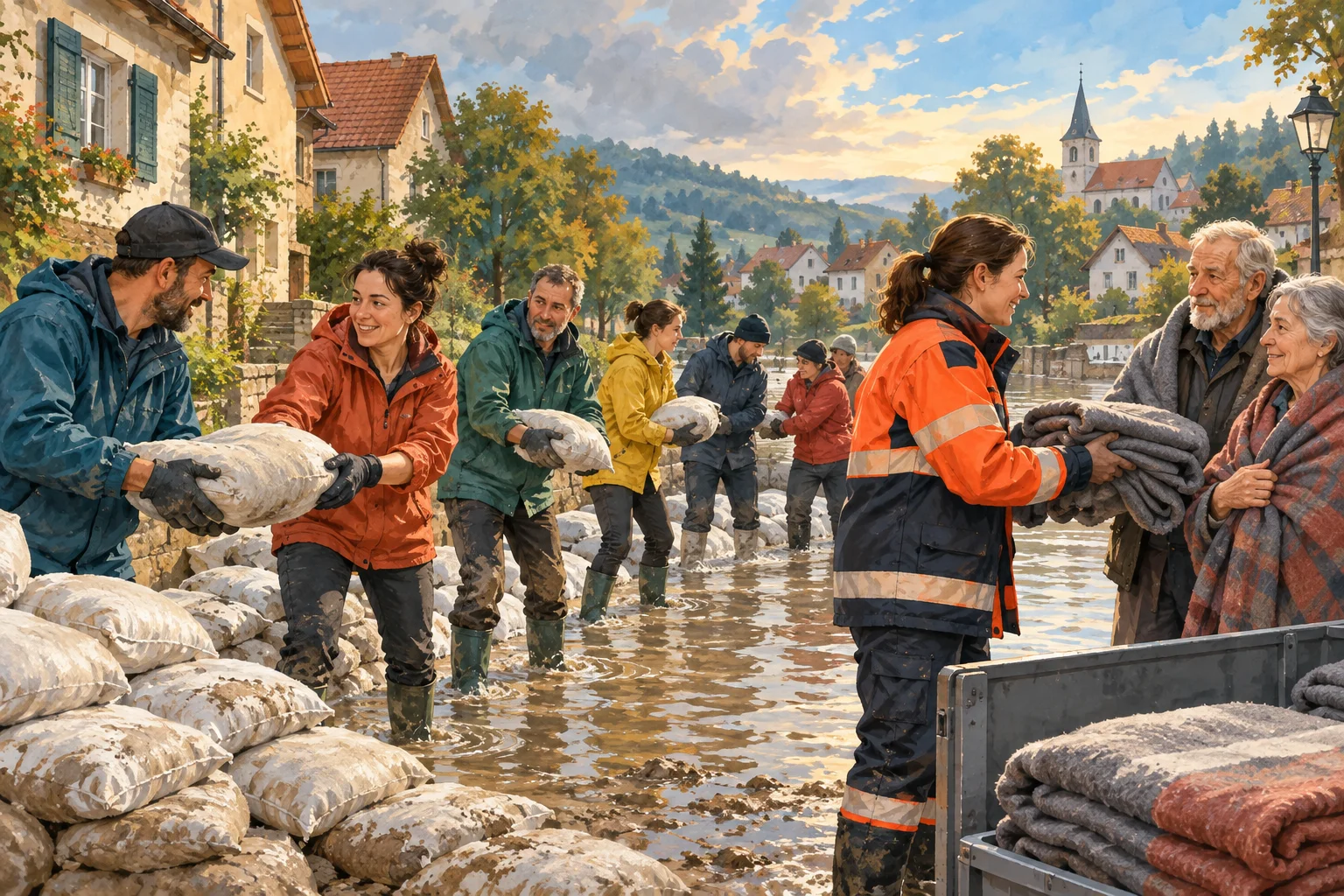
Hunderte Helfer füllten Sandsäcke und sicherten die Deiche.
Hundreds of helpers filled sandbags and secured the dykes.
Am Morgen waren viele Straßen nicht mehr befahrbar.
In the morning many roads were no longer passable.
Der Landkreis rief den Katastrophenfall aus.
The district declared a state of emergency.
Many verbs here are irregular: steigen, stieg; rufen, rief; sein, war. Separable prefixes go to the end: Der Pegel stieg an. Der Katastrophenfall is a state of emergency, der Deich a dyke and der Sandsack a sandbag.
03
Look back and describe the situation now
Reports also look back and forward. Events that happened before the main story take the Plusquamperfekt: Die Behörden hatten gewarnt. The current situation and ongoing aid are in the Präsens: Inzwischen sinkt der Pegel.
| Use in a report | Tense | Example |
|---|---|---|
| what has happened, at the start | Perfekt | Der Fluss ist über die Ufer getreten. |
| the events in order | Präteritum | Der Pegel stieg an. |
| what had happened before | Plusquamperfekt | Die Behörden hatten gewarnt. |
| the situation now | Präsens | Der Pegel sinkt. |
Die Behörden hatten bereits am Vortag vor dem Hochwasser gewarnt.
The authorities had already warned of the flood the day before.
Viele Familien hatten ihre Keller rechtzeitig geräumt.
Many families had cleared their cellars in time.
Inzwischen sinkt der Pegel langsam wieder.
Meanwhile the water level is slowly falling again.
Hilfsorganisationen sammeln jetzt Spenden für die Betroffenen.
Aid organisations are now collecting donations for the people affected.
The Plusquamperfekt uses hatte or war plus the participle. Die Betroffenen means the people affected, die Hilfsorganisation an aid organisation and die Spende a donation.
Ready to try it?
Check what you remember with 12 short questions.
Loading quiz…