B2-83 · Tell what had happened before
Post-war Germany
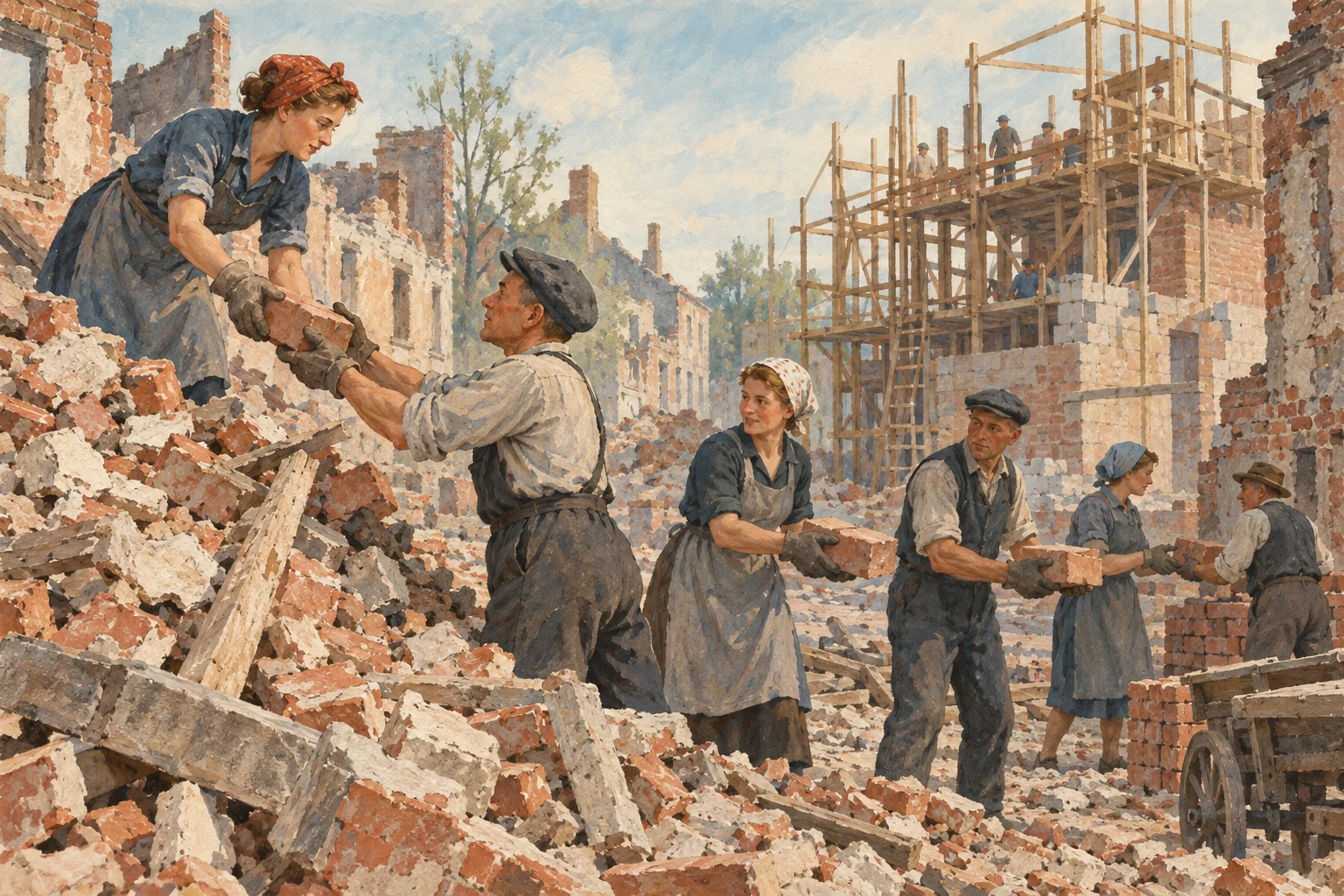
Use the Plusquamperfekt with nachdem, bevor, sobald and als to tell the story of reconstruction and the economic miracle.
About 5 minutes to read · 12 quiz questions
01
Plusquamperfekt: hatte or war plus participle
The Plusquamperfekt describes something that had already happened before another past event. Form it with the Präteritum of haben or sein plus the participle: Bomben hatten die Innenstadt zerstört. Verbs that take sein in the Perfekt, such as gehen, kommen and fliehen, take war or waren.
Der Krieg war im Mai 1945 zu Ende gegangen.
The war had ended in May 1945.
Bomben hatten große Teile der Innenstadt zerstört.
Bombs had destroyed large parts of the city centre.
Meine Großmutter hatte ihre Wohnung verloren.
My grandmother had lost her flat.
Viele Familien waren aus ihrer Heimat geflohen.
Many families had fled from their homeland.
Die Trümmer (plural) means rubble, der Wiederaufbau reconstruction and die Heimat homeland. Fliehen (to flee) has the participle geflohen and uses sein, and so does zu Ende gehen (to end).
02
nachdem: one step before the next
Nachdem introduces the earlier event. If the main clause is in the Präteritum, the nachdem clause is in the Plusquamperfekt: Nachdem der Krieg zu Ende gegangen war, räumten die Menschen die Trümmer weg. The finite verb goes to the end of the nachdem clause.
| Time of the story | nachdem clause | main clause |
|---|---|---|
| past | nachdem er gegessen hatte | ging er los |
| present | nachdem er gegessen hat | geht er los |
Nachdem der Krieg zu Ende gegangen war, räumten die Menschen die Trümmer weg.
After the war had ended, people cleared away the rubble.
Nachdem die neue Währung gekommen war, füllten sich die Schaufenster wieder.
After the new currency had arrived, the shop windows filled up again.
Nachdem mein Großvater eine Lehre gemacht hatte, fand er Arbeit in einer Fabrik.
After my grandfather had done an apprenticeship, he found work in a factory.
Die Familie zog in eine neue Wohnung, nachdem die Stadt das Haus wieder aufgebaut hatte.
The family moved into a new flat after the town had rebuilt the house.
Do not use the same tense on both sides. The usual pairs are Plusquamperfekt with Präteritum, or Perfekt with Präsens. Die Währung means currency, das Schaufenster shop window and die Lehre apprenticeship.
03
bevor, sobald and als
Bevor introduces the later event, so the earlier event in the main clause can be in the Plusquamperfekt. Sobald means as soon as, and als is used for a single event in the past. The rapid economic growth of West Germany in the 1950s became known as the Wirtschaftswunder, the economic miracle.
Bevor das Wirtschaftswunder begann, hatten viele Menschen jahrelang gehungert.
Before the economic miracle began, many people had gone hungry for years.
Sobald mein Großvater die Prüfung bestanden hatte, bekam er eine feste Stelle.
As soon as my grandfather had passed the exam, he got a permanent job.
Als die ersten Gastarbeiter aus Italien kamen, hatte der Wiederaufbau längst begonnen.
When the first guest workers came from Italy, reconstruction had long since begun.
Erst nachdem sie jahrelang gespart hatten, kauften sie ein Auto.
Only after they had saved for years did they buy a car.
Do not use wenn for a single past event; use als. Erst nachdem means only after. Der Gastarbeiter (guest worker) is the historical term for workers recruited from abroad from 1955, starting with Italy.
Ready to try it?
Check what you remember with 12 short questions.
Loading quiz…